

My friend Sara texted me last week saying she wanted to buy AirPods but had no idea which model to get. She'd looked at Apple's website and ended up more confused than before she started. Four models, different price points, features she'd never heard of.
I told her give me a day. I went through every current model properly and here's exactly what I found.
The Current AirPods Lineup in 2026
Before anything else, here's the quick rundown of what Apple currently sells.
The current AirPods lineup includes AirPods Pro 3, AirPods 4, AirPods 4 with Active Noise Cancellation, and AirPods Max 2. Wikipedia
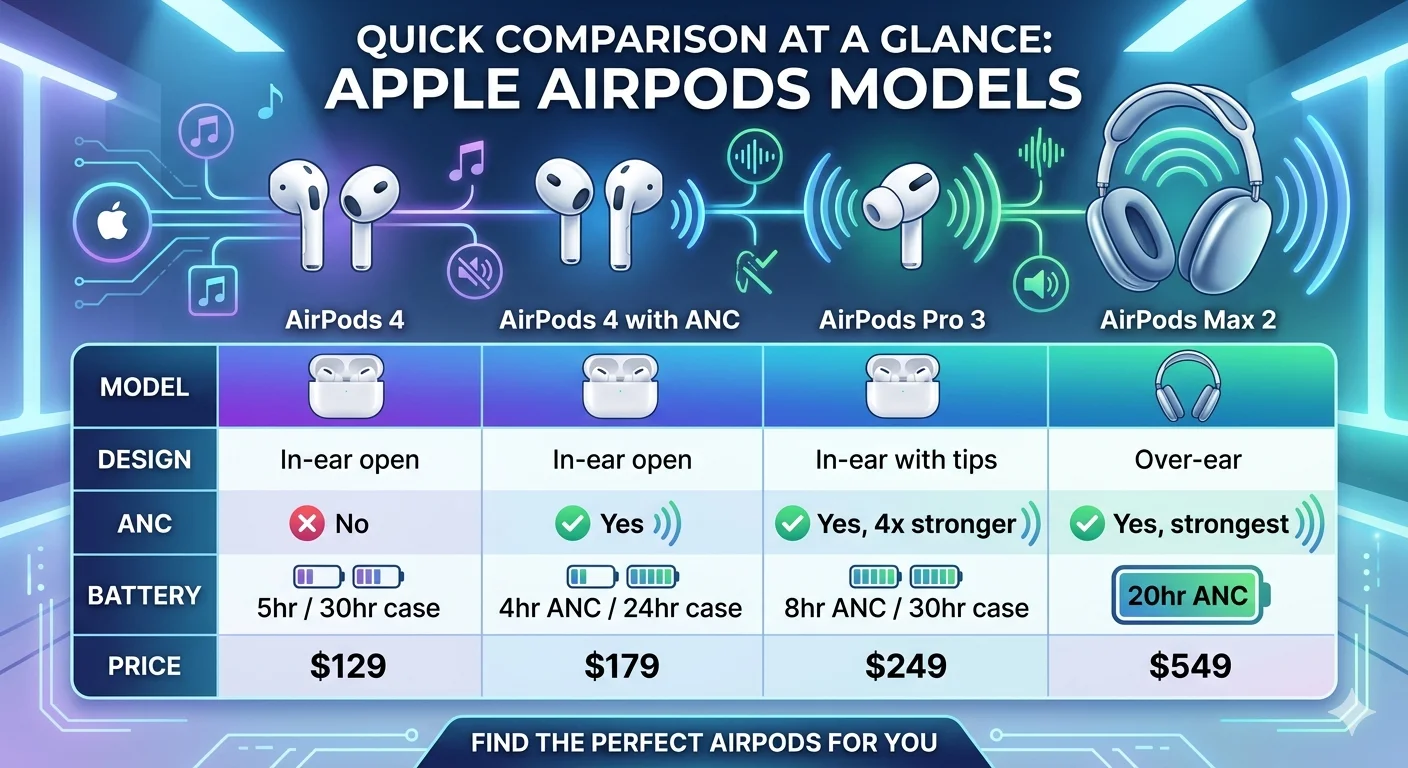
Four models. Two categories. In-ear earbuds on one side, over-ear headphones on the other. Here's the price ladder as of June 2026:
AirPods 4 — $129
AirPods 4 with ANC — $179
AirPods Pro 3 — $249
AirPods Max 2 — $549
That's a $420 gap between entry and top. Let me walk through what each one actually does so you know whether any of those prices make sense for your situation.
Quick Comparison at a Glance
 AirPods 4: The Clean Starting Point
The AirPods 4 are the base model and they're genuinely good for what they are.
AirPods 4 are a good choice if you want reliable headphones that cover the basics without spending more than you need to. The open fit feels light and familiar and they're easy to wear throughout the day.
The open fit design means no silicone ear tips pressing into your ear canal. A lot of people find this significantly more comfortable for all-day wear. If you've tried AirPods in the past and liked how they sat in your ear, this is that same feeling.
You get around 5 hours of listening on a single charge with up to 30 hours total using the USB-C charging case. They're also resistant to dust, sweat, and water, so they hold up well for walking, light workouts, or your usual daily routine.
The honest limitation: no Active Noise Cancellation, no Adaptive Audio, no Transparency Mode. What you get is good audio quality and a clean design for everyday use. Nothing more, nothing less.
If you just want wireless earbuds that sound good, stay in your ears, and don't cost a lot, this is the one.
AirPods 4 with ANC: The Sweet Spot for Most People
Here's the thing. The $50 difference between the base AirPods 4 and the ANC version adds features that genuinely change how you use them every day.
The ANC version adds Active Noise Cancellation, Adaptive Audio, Transparency Mode, and Conversation Awareness. Those are not minor upgrades.
Adaptive Audio is the standout. It continuously blends ANC and Transparency based on your environment automatically. Walking past a loud construction site, it blocks noise out. Someone starts talking to you, it lets their voice through. You don't touch anything. It just adjusts.
Battery with Active Noise Cancellation is up to 4 hours of listening time on a single charge with up to 24 hours total using the charging case.
The trade-off is one less hour of per-charge listening when ANC is on. That's a reasonable price for the feature set.
Up to 2x more Active Noise Cancellation compared with original AirPods Pro and AirPods 4 with Active Noise Cancellation when tested in accordance with IEC 60268-24.
Wait, that's actually from the Pro 3 section. The AirPods 4 ANC version provides meaningful noise cancellation for everyday environments like offices and coffee shops. It won't block a loud flight engine completely but it handles most real-life noise well.
For most people who want a versatile everyday earbud, $179 for the AirPods 4 with ANC is where I'd point them.
AirPods Pro 3: The Best In-Ear Option Apple Makes
The AirPods Pro 3 are Apple's flagship earbuds and they earn that position.
The AirPods Pro 3 are Apple's latest flagship in-ears with better bass than their predecessors and active noise cancellation that's twice as effective.
The silicone ear tips create a seal in your ear canal. That seal is what allows significantly stronger noise cancellation compared to the open-fit AirPods 4 design. You can't get deep ANC from an open-fit design. Physics doesn't allow it.
Up to 4x more Active Noise Cancellation than original AirPods Pro and AirPods 4 with Active Noise Cancellation when tested in accordance with IEC 60268-24.
Four times stronger noise cancellation than the base models is genuinely noticeable. On a plane, in a loud gym, commuting on a train, the difference between Pro 3 ANC and AirPods 4 ANC is something you feel immediately.
Battery is up to 8 hours of listening time on a single charge with Active Noise Cancellation on, with up to 30 hours total using the charging case.
Eight hours of ANC listening on a single charge is excellent for an earbud. The AirPods 4 gets 4 hours with ANC on. That difference matters on a long travel day.
The Pro 3 also has IP57 water resistance compared to IP54 on the AirPods 4 models. More protection from water ingress if that's relevant to how you use them.
The health features are worth mentioning too. The Pro 3 includes a Hearing Test, Hearing Aid functionality, and Hearing Protection built in. For anyone with mild to moderate hearing loss, the Hearing Aid feature specifically is something genuinely valuable that no other mainstream earbud has.
If you commute, travel, exercise seriously, or just want the best possible earbuds Apple makes, the Pro 3 at $249 is the right call.
AirPods Max 2: The Premium Over-Ear Option
The AirPods Max 2 are in a completely different category from the earbuds. This is an over-ear headphone, not an earbud, and the use case is fundamentally different.
AirPods Max 2 are designed for listening at home, on flights, or when traveling. The cushioned over-ear design sits around your ears rather than in them which many people find more comfortable over time. They support ANC, Adaptive Audio, Transparency Mode, and Lossless Audio.
The Lossless Audio support is the feature that audio enthusiasts care about specifically. When connected via USB-C to a compatible device, you can listen to Apple Music in Lossless quality. The H2 chip in each ear cup handles the processing needed for that audio fidelity.
Battery is up to 20 hours of listening time on a single charge with Active Noise Cancellation enabled.
Twenty hours. That's a full long-haul flight with hours to spare. For serious listening sessions, that battery advantage over earbuds is significant.
Adaptive Audio is available on AirPods Max 2 with the latest firmware when paired with compatible devices running iOS 26.4 or iPadOS 26.4 and later.
Adaptive Audio finally came to AirPods Max 2 with the iOS 26.4 update, which is actually recent. If you have an older AirPods Max 2 and haven't updated, make sure you're running iOS 26.4 to get this feature.
The honest downside: the only downside is size and weight. At over 13 ounces they're noticeably heavier than AirPods earbuds making them less convenient to carry or use on the go.
These are not commuting earbuds. They're not workout earbuds. They're a premium listening experience for when you're sitting on a plane, working at a desk, or relaxing at home. If that's your use case and you're in the Apple ecosystem, they deliver.
At $549 though, they're not competing with mid-range earbuds. They're competing with Sony XM6s and Bose QuietComfort Ultra 2. On pure audio quality and ecosystem integration, the Max 2 holds up but the price requires a clear use case to justify it.
The Feature Breakdown: What Each Model Gets
Let me be specific about the features that matter most and which models have them.
Active Noise Cancellation
AirPods 4: No ANC.
AirPods 4 with ANC: Yes, moderate ANC. Good for offices and coffee shops.
AirPods Pro 3: Yes, up to 4x stronger than the base models. Best-in-class for earbuds.
AirPods Max 2: Yes, strongest ANC in the lineup. Up to 1.5x more than the original AirPods Max.
Adaptive Audio
Not available on base AirPods 4. Available on all three other models. This is the automatic blending of ANC and Transparency that adjusts to your environment without manual input.
Transparency Mode
Not on AirPods 4. Available on AirPods 4 with ANC, Pro 3, and Max 2. Lets external audio through naturally while keeping your earbuds in.
Conversation Awareness
Not on AirPods 4. Available on all ANC models. Detects when you start talking and automatically lowers music volume and lets your voice and nearby voices through.
Personalized Spatial Audio
Available on all models. Creates a 3D audio experience that adapts to your head movements. The quality of spatial audio improves on higher-end models but every AirPod in 2026 supports the feature.
Hearing Health Features
Exclusive to AirPods Pro 3. Hearing Test, Hearing Aid, and Hearing Protection are clinical-grade features that differentiate the Pro 3 significantly from everything else in the earbud lineup.
Battery Life Side by Side
Here's the honest battery comparison in real-world terms.
AirPods 4 give you 5 hours of listening per charge, 30 hours total with the case. No ANC so battery isn't affected by noise cancellation.
AirPods 4 with ANC give you 4 hours with ANC on, 24 hours total with case. One hour shorter per charge because ANC processing draws power.
AirPods Pro 3 give you 8 hours with ANC on, 30 hours total with case. Significantly longer per-charge life than the AirPods 4 models despite having much stronger ANC. That efficiency improvement is noticeable.
AirPods Max 2 give you 20 hours with ANC on per charge. No charging case, just a Smart Case for storage. USB-C charging.
Fit Comfort: Open vs Sealed
This is the one that comes down to personal preference more than specs.
The AirPods 4 and AirPods 4 with ANC use an open-fit design with no ear tips. They sit in the outer ear without sealing the canal. Some people love this for all-day comfort. Others find they fall out during movement or don't stay secure during workouts.
Compared to AirPods 4, the Pro 3 feel more locked in which can take a little getting used to. However that added stability is what makes them a more reliable option when you're on the move.
The Pro 3 uses silicone ear tips that come in four sizes. Getting the right size matters enormously for both comfort and ANC performance. The wrong size tip means worse ANC and potential discomfort over long listening sessions.
The Max 2 is over-ear with cushioned ear cups. Most people find over-ear more comfortable for extended sessions. But they're physically larger and heavier than earbuds and not everyone wants to wear them outside.
Which AirPods Should You Actually Buy
Let me make this concrete.
You want something affordable that just works for daily use: AirPods 4 at $129. Clean, comfortable, good audio, no fuss.
You want the best value in the lineup with real features: AirPods 4 with ANC at $179. Adaptive Audio and Transparency Mode make everyday life noticeably better for $50 more.
You commute, travel, exercise, or want the best earbuds Apple makes: AirPods Pro 3 at $249. The ANC strength, battery life, and hearing health features justify every dollar over the AirPods 4.
You want premium over-ear listening for home, flights, or serious audio sessions: AirPods Max 2 at $549. Only make sense in the Apple ecosystem and only if you'll genuinely use the over-ear form factor.
The Apple Ecosystem Advantage
Here is the thing that makes all of these better than comparable non-Apple earbuds for iPhone users.
Automatic switching between your iPhone, iPad, Mac, and Apple Watch happens seamlessly without manually disconnecting and reconnecting. You pick up your iPad and the audio switches. You get a call on your iPhone and it switches back. That experience is genuinely better than anything non-Apple does.
Speaking of the Apple Watch connection, if you're running the latest watchOS 26.4 update, Adaptive Audio on AirPods Max 2 works with iOS 26.4 and later which just became available. If you want the full breakdown on what else watchOS 26.4 brought to the Apple Watch, our watchOS 26.4 new features guide covers everything that changed in that update and how it connects to the broader Apple ecosystem.
AirPods With Non-Apple Devices
If you don't have an iOS device like the iPhone 17 then probably not. Yes Apple's AirPods do work with other devices but to get the best out of them you really need to have at least one foot in Apple's ecosystem.
Basic Bluetooth audio works on Android and Windows. But automatic device switching, Siri integration, automatic ear detection, one-tap pairing, and all the smart features require Apple devices running compatible software.
If you're primarily an Android user, Sony WF-1000XM6 or Samsung Galaxy Buds 3 Pro will serve you significantly better for the same money.
You can find the full official feature comparison for every current model directly on Apple's AirPods compare page which shows every spec side by side with full compatibility details.
FAQs
Which AirPods are best in 2026?
AirPods Pro 3 for the best all-around earbuds. AirPods 4 with ANC for the best value. AirPods Max 2 for premium over-ear listening.
What is the difference between AirPods 4 and AirPods Pro 3?
Pro 3 has significantly stronger ANC, silicone ear tips for better seal, longer battery life, hearing health features, and IP57 water resistance versus IP54 on AirPods 4.
Are AirPods Max 2 worth $549?
Only if you want over-ear comfort, the strongest ANC in the lineup, Lossless Audio support, and 20 hours of battery. For casual daily use, the earbuds offer better value.
Do AirPods work with Android phones?
Basic Bluetooth audio works but smart features like automatic switching, Siri, and one-tap pairing require Apple devices running compatible software.
What is Adaptive Audio on AirPods?
Adaptive Audio automatically blends Active Noise Cancellation and Transparency Mode based on your environment without any manual adjustment needed.